
What is Orange County Point-In-Time Count?
The Point-in-Time (PIT) Count helps Orange County understand how many people are experiencing homelessness and what services and support are needed. This information helps improve housing programs, services, and resources for individuals and families across the county.
Orange County conducts the PIT Count every two years in January, as required by the U.S. Department of Housing and Urban Development (HUD). During this time, trained volunteers go throughout the county to count and survey people staying in shelters, outdoors, in vehicles, or in other places not meant for housing.
Volunteers ask a few short questions, such as age, family status, veteran status, and health-related needs. This helps the County better understand people’s situations and identify the types of support that may be most helpful.
After the count, the information is reviewed to remove duplicates and ensure accuracy. The results are then combined and used to help improve services, housing opportunities, and resources for people experiencing homelessness across Orange County.
Current Count Conducted: January 2026
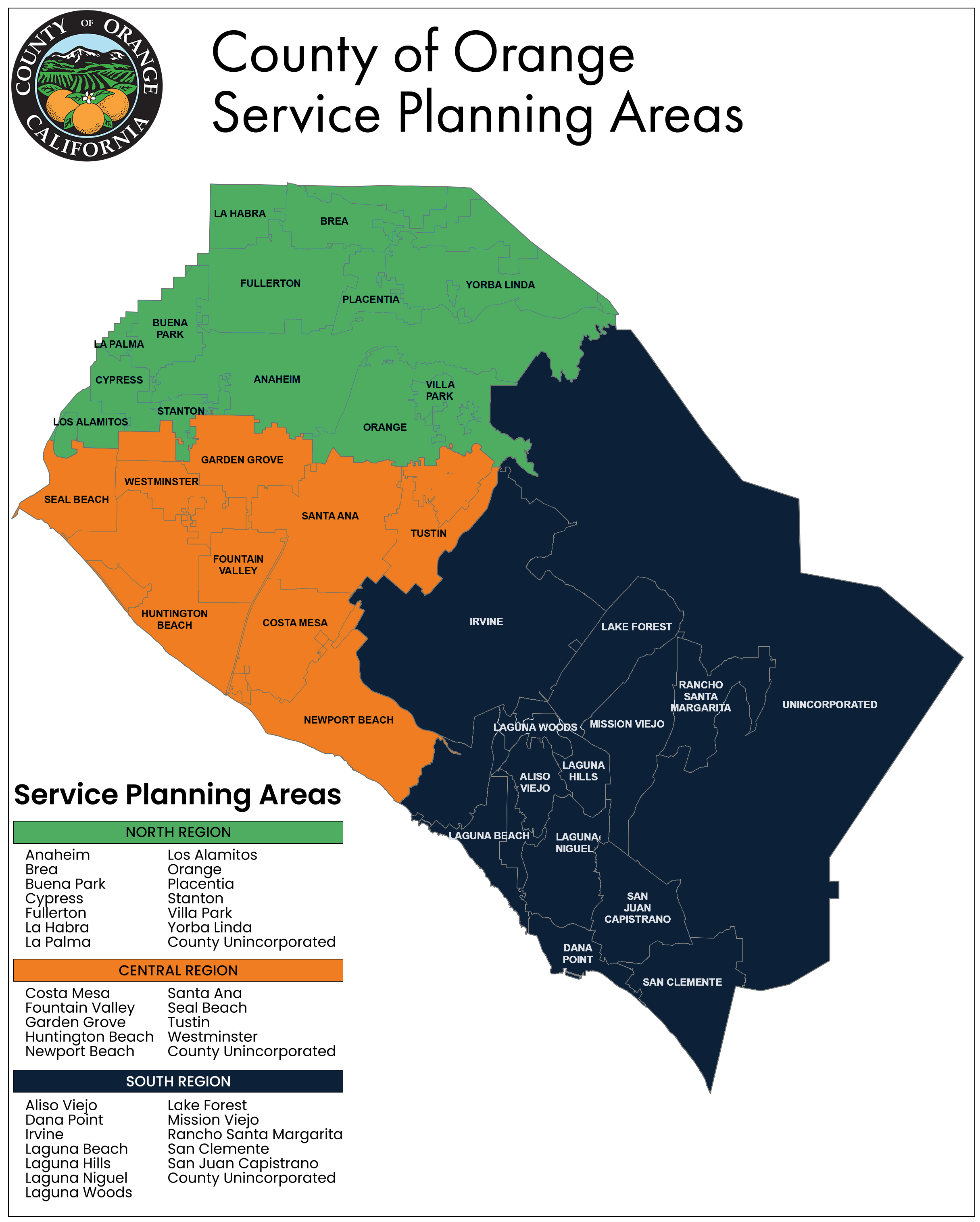
What is the OC Service Planning Area (SPA)?
Orange County is divided into three regions, North, Central, and South, to better understand needs and provide services to people experiencing homelessness.
The Central region includes cities such as Santa Ana, Garden Grove, Westminster, Fountain Valley, and Tustin. This area has many shelters, services, and public resources, and serves a large number of individuals and families experiencing homelessness.
Dividing the County into regions helps ensure that services and resources are better coordinated and tailored to meet the needs of each community.
2026 Point-in-Time Count
Orange County at a Glance
A snapshot of homelessness across all three service planning areas, based on the most recent Everyone Counts OC data.
Source: Everyone Counts OC, January 2026 Point-in-Time Count
Sheltered vs. Unsheltered
Breakdown by Region
The Central region accounts for nearly half of all unsheltered individuals countywide, highlighting the urgent need for expanded services.
Historical Trend
Regional Counts Over Time
Every region climbed sharply from 2022 to 2024, then declined in the 2026 count. North and Central remain above their 2022 levels, while South fell below it.
Key Populations
Who Is Affected
Sheltered and unsheltered counts for transitional-aged youth, seniors, and veterans. These populations face unique housing challenges and are priority populations for homeless services and housing interventions.
Seniors (882 individuals) represent the largest key population identified during the PIT Count. Veterans had the highest proportion of unsheltered homelessness (68%), compared with 38% of transitional-aged youth and 40.9% of seniors, highlighting the differing housing and homeless service needs among these populations.
Central Cities Focus
Homelessness Trends in the Central Cities
Garden Grove, Fountain Valley, and Westminster recorded a combined 586 people experiencing homelessness in the 2026 Point-in-Time Count. Counts across the three cities have remained relatively consistent since 2022, ranging from 586 to 641 individuals.
Of the 586 individuals identified in 2026, 437 were unsheltered and 149 were sheltered. The Point-in-Time Count data provide a snapshot of homelessness and are used to inform housing strategies, local planning, and service delivery efforts. The Central Cities Navigation Center is one of several regional initiatives intended to expand access to temporary housing and supportive services.